



Wilder T4 astronomical theodolite
"Wilder T4 astronomical theodolite" is a high-precision angle measuring instrument designed for astronomical observation. It is mainly used to determine the position, trajectory and atmospheric refraction of celestial bodies (such as stars, planets, comets). In its name, "Wild" usually refers to the manufacturer of traditional astronomical instruments in Germany or Switzerland. "T4" is the model code and represents its technical iteration version. "Astronomical Theodolite" defines its core function-to realize precise measurement of azimuth and altitude of celestial bodies through telescope and dial system.

Universal solar ring for astronomical instruments in the eighteenth century
This instrument was manufactured around 1760 and was one of the most advanced astronomical measurement tools of the time. By using the Universal Dayring, astronomers can accurately measure the position of the sun during the day to determine time and orientation. This instrument was widely used in the 18th century to help astronomers with celestial observation and navigation.

16th century astronomical instrument sundial
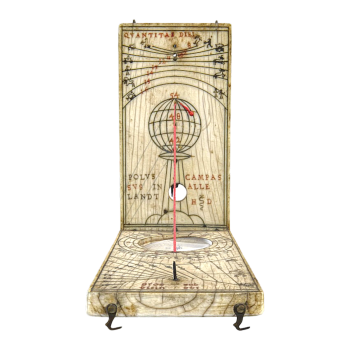
Seventeenth Century Astronomical Instrument Hand-held Folding Ivory Sundial

Seventeenth Century Astronomical Instruments Small Ring Sundial
The ring sundial was a sophisticated instrument used to measure time at the time. Its design combines science, technology and art, symbolizing the era's quest for time and astronomical knowledge. The working principle of the ring sundial is based on the position of the sun, and the time is determined by reading the projection of the sun on the dial.

Eighteenth-century astronomical instrument cube sundial
The cube sundial is a scientific instrument used to determine time. In the 18th century, the sundial was an important time-measuring tool that scientists and explorers relied on for astronomical observation and navigation.
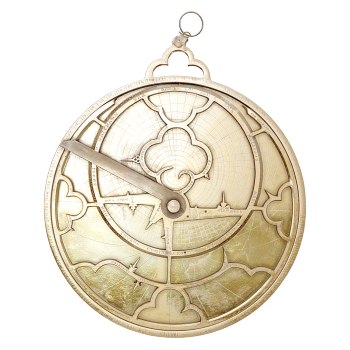
Medieval flat star chart
The star chart is an ancient astronomical instrument, which can be said to be a handheld model of the universe. Its various functions also make it a sophisticated inclinometer and an analog computing device capable of solving several problems in astronomy. In its simplest form, it is a metal disk with patterns of wires, cuts, and perforations, allowing users to accurately calculate the position of celestial bodies. Astronomers throughout history have used it to measure the height of celestial bodies on the horizon, both during the day and at night; It can be used to identify stars or planets, determine the local latitude at a given local time, measure or conduct triangulation.

3D model of astronomical telescope
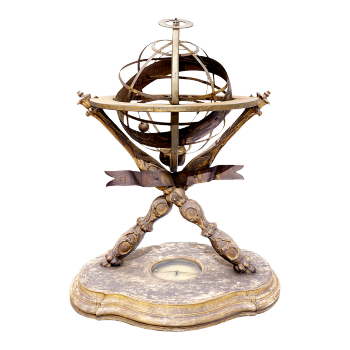
Celestial globe
The celestial globe is a general term for the celestial globe and the celestial globe. The armillary sphere is an instrument used to measure the spherical coordinates of celestial bodies, while the celestial globe was an instrument used in ancient times to demonstrate celestial phenomena. The armillary sphere and the celestial globe are instruments that reflect the theory of the celestial sphere. The inventor of the armillary sphere is said to be Luo Xiahong from the Western Han Dynasty, who was improved by scientist Zhang Heng during the Eastern Han Dynasty. The earliest existing armillary sphere in China was manufactured during the Ming Dynasty and is displayed at the Purple Mountain Observatory in Nanjing.

Astronomical pentameter in the first half of the 19th century
Built by artist Joseph von Utzschner in the first half of the 19th century, this instrument is an observational astronomical device used to determine the height of celestial bodies above the horizon. It consists of a frame limited by two radii, an arc with a scale, an observation telescope, and a mirror system. It is used to determine the position of celestial bodies by using a mirror system that produces a reflection image of the observed object parallel to the horizon in the observer's field of view. In order to observe the position of the sun, a filter is used to limit the amount of light reaching the observer's eyes. The instrument is currently housed in the Jagiellonian University Museum in Munich, Germany.

Astronomical pentameter
The Astronomical Quintant, also known as the Astronomical Goniometer, is an ancient astronomical instrument used to measure the elevation angle of celestial bodies. It consists of a quarter arc and a movable cursor. The principle of the astronomical pentameter is based on the method of triangulation. When the observer raises the astronomical pentameter towards the sky, the cursor can move to align with the line of sight of a celestial body. Surveyors can determine the elevation angle of celestial bodies by reading the scale on the cursor. Usually, the scale on an astronomical pentameter is spaced at intervals of five degrees, hence it is called a pentameter.

astronomical observation instrument
An observational astronomical instrument of the first half of the 19th century used to determine the height of a celestial body above the horizon. It consists of a frame limited by two radii and a graduated arc, an observation telescope and a mirror system. The 1/5 arc is the fifth part of the circle, hence the name, similar to the quadrants, 1/6, and 1/8 (based on the fourth, sixth, and eighth parts of the circle, respectively). It is currently housed in the Jagiellon University Museum in Munich, Germany.

Popular Models
Honey Badger (3D animated model)
192 View
Guinea fowl (3D animated model)
163 View
Wild Goose (3D animated model)
185 View
Red Fox (3D animated model)
153 View
Random Model


German Hildebrand Defense Ship
625 View

Soviet-era GAZ-52 trucks
681 View
Ski goggles 3D model
1231 View

Vortex Worm (3D Structural Diagram)
953 View

(mantis) specimen
823 View

Stone Bergamot
955 View
